

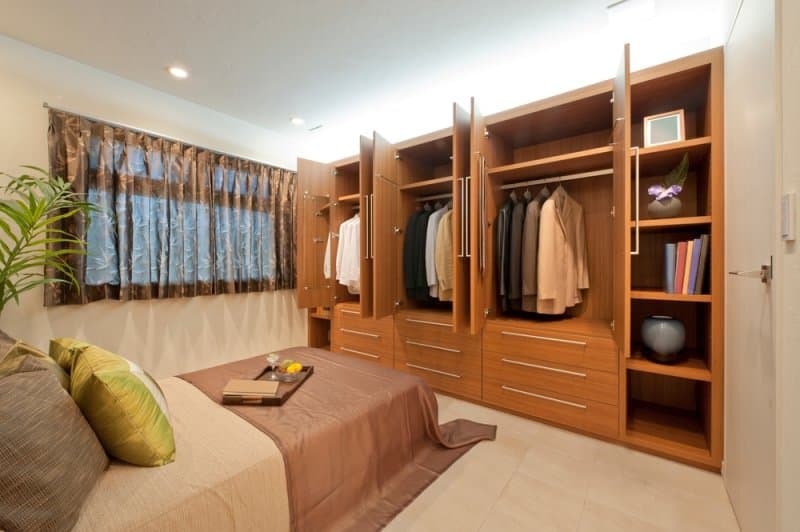
When you're purchasing a wardrobe, you want it to last a long time, so you want to put as much thought into what it's made of as into the way it looks and the amount of storage space it offers.
The most suitable material for wardrobes will be based on the level of usage, your budget, and the types of conditions found in your bedroom.
There are many factors to consider when it comes to the best material for wardrobes. Some are more durable than others or have a flat surface that is easy to clean, and some are a low-cost option for storing things.
The four main wardrobe material types to choose from are plywood, medium-density fiberboard (MDF), particleboard, and solid wood wardrobes. There are different disadvantages and benefits to all wardrobe material types, so your decision should depend on your storage needs as well as the size of your bedroom.
Understanding the various materials used to create wardrobe furniture makes it much easier to buy. Take a look at these four options and why they might be suitable for your needs.
Plywood is a layered structure of thin plies, with wood grain in alternate directions. It is made of layers of thin slices of wood glued together with high-quality wood glue in alternate directions. Good in strength, stable, and durable for structural applications; ideal for wardrobe frames, shelves, doors & inside partitions.
Everyday grain's strongest point is that it can securely grip nails, and it can be used for everyday weight. Medium-density plywood also resists the fluctuations of occasional humidity more effectively than MDF and particleboard if the edges are sealed.
A lot of the furniture you might have in your home, such as its doors (e.g., wardrobe doors), is made using MDF. MDF stands for medium-density fiberboard and involves compressing wood fibers using resin and heat. This results in an MDF surface that is really smooth and even and great for painted wardrobe doors or decorative panels, as well as the end of contemporary furniture.
Nevertheless, MDF will swell if it comes into contact with water or if the relative humidity of the room remains high for a long time. It is usually less expensive than high-quality plywood and solid wood, so it is more suitable for dry bedrooms.
It's a wardrobe made from natural timbers, such as oak, maple, walnut, or pine. Its natural color and grain can make a very desirable furniture piece for a traditionally styled and more luxurious bedroom.
This is the most hard-wearing and durable option, which can also be repaired or refinished if necessary. Unfortunately, it tends to be pricier than engineered wood and is susceptible to fluctuating humidity.
Particleboard is made of wood chips, sawdust, and resin that is pressed into sheets. It is often found in inexpensive pre-assembled furniture and wardrobes with laminate or melamine surfaces.
Particleboard is relatively light and inexpensive, but less moisture-resistant and less durable under load than quality plywood. It's suitable for simple storage in dry areas; it might not be durable enough for the average wardrobe used daily for decades.
Overall, plywood vs MDF for wardrobes will come down to strength, resistance to moisture and surface finish, and cost. Plywood is a bit more suitable for use in the construction of the wardrobe.
If you are planning on painting and applying decorative designs, then an MDF wardrobe provides a much smoother surface. Unless your wardrobe is going to be heavy and needs to store a lot of weight, go with plywood. MDF is a good choice if you want painted doors and you don't want to spend too much money.
The appropriate plywood to use for building wardrobes will be based on the moisture level and how much wear and tear the piece of furniture will have. High-quality hardwood plywood grades are suitable for the wardrobe's panels, shelves, and frames.
Moisture-resistant plywood (weather-resistant or water-resistant) is suitable where bedrooms are subject to variable moisture levels; other, more moisture-resistant grades (BWR or BWP) are suitable where relevant. But these do not make the wardrobe totally watertight. Always check the panel quality, manufacturer's specifications, and edge sealing.
In terms of long-term strength, solid wood and quality plywood are some of the most hard-wearing building materials you can choose. Solid wood can last for many decades when cared for, and quality plywood will give solid strength without the cost of many solid wood options.
An engineered wood wardrobe will also last if it has the right panels, good quality hardware, joints, and the right finish. And the entire design itself is important.
The ability to choose the right material for a wardrobe depends not only on its aesthetic characteristics. Consider the following factors before you buy.
Also look at the quality of hinges, drawer runners, joints, and edge protection. A material for a wardrobe, even as good as it is, will not hold if it is badly constructed with weak fittings.
While there are many different qualities of materials used to build wardrobes, the decision often boils down to budget, storage requirements, bedroom moisture resistance, environment, and individual taste.
Plywood is a popular general-purpose wardrobe material. MDF lends itself to decorative finishes, with solid wood and particleboard material offering increased natural appeal and durability—at a price.
Do wood products that are labeled with adhesives and chemicals potentially be responsible for them gradually releasing formaldehyde? Yes. Refer to product certification and emissions data. Select lower-emission materials whenever possible.
The wardrobe finished with laminate is by nature very easy to keep clean. Just remove dust and clean with a slightly damp cloth. Avoid too much water, aggressive chemicals, and abrasive cleaners.
Yes, you will notice different things radiating through your wardrobe panels depending on the material used, especially if the panels are thicker and heavier, as you will get more sound dampening than with lightweight, thinner sheet material.
Yes, it's quite normal to mix and match items with furniture these days. You might, for example, find a wardrobe made with a plywood carcass, MDF doors, and metal handles and fittings. All to reduce cost without compromising on strength or appearance.
Check for rough surfaces, cracked edges, separate layers, bumps or soft spots, and spongy joints. Request the grade, the moisture resistance, the thickness of the material, and whether the furniture is covered by the manufacturer's warranty.
This content was created by AI