

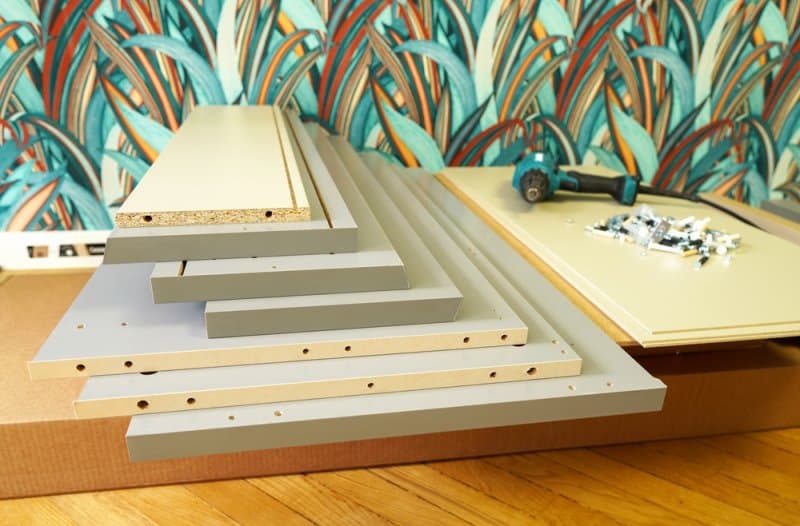
MDF has a reputation problem. Some people call it fake wood, while others call it just as good. Neither holds up. The real differences show up in specific spots, like a wet vanity or a long bookshelf. In this blog, we cover seven facts about solid wood vs. MDF that explain cost, strength, and durability, so you can choose by how the furniture gets used.
Here's the big picture. The solid wood vs. MDF table below sums up the factors buyers care about most.
| Factor | Solid Wood | MDF |
| Price | Higher | Lower |
| Screw holding | Strong, reusable | Weak after reuse |
| Water resistance | Moderate, recovers | Poor, swollen for good |
| Seasonal movement | Expands and contracts | Very stable |
| Paint finish | Grain may show | Smooth and even |
| Repairability | Sand and refinish | Limited |
No material wins every row. That's why the MDF vs. solid wood question has no single answer.
MDF means medium-density fiberboard. It's fine wood fiber mixed with resin and pressed into sheets.
Solid wood is cut straight from a log, with natural grain running through it. MDF has no grain, so it's uniform but less forgiving under stress. Think of solid wood vs. MDF as natural structure versus manufactured consistency. Every other MDF vs. solid wood difference flows from that.
MDF vs. solid wood cost differences can be large, especially against oak. The gap isn't just brand markup.
Solid wood needs mature trees, slow drying, and more cutting waste. MDF uses sawmill leftovers pressed into sheets with little waste. Labor matters too, since solid pieces use joinery while MDF is machine-cut.
MDF vs. solid wood cost gaps can reach hundreds of dollars per dresser, so weigh MDF vs. solid wood cost against lifespan. In solid wood vs. MDF budgets, cheap upfront isn't always cheap overall.
MDF vs. solid wood strength isn't a simple ranking. MDF is stiff in small panels but weaker over long spans. A 36-inch MDF shelf loaded with books may sag over time, while solid oak of the same size usually stays straight.
For heavy loads, solid wood vs. MDF favors solid wood every time, and MDF vs. solid wood strength gaps widen as spans grow.
Durability means handling damage, not avoiding it. MDF vs. solid wood durability splits clearly here.
Solid wood lasts longer because you can sand out scratches and refinish it. MDF vs. solid wood durability looks close for a few years, but a chipped MDF corner rarely repairs invisibly.
Picture a kitchen table after a decade. Solid wood can be refinished, while MDF often needs replacing, which is why MDF vs. solid wood durability shifts solid wood vs. MDF decisions for long-term pieces.
If you remember one rule, make it this one. Moisture changes MDF permanently and hurts MDF vs. solid wood durability more than anything else.
Yes. When water reaches unsealed edges, the fibers swell, and the swelling stays after drying. Moisture-resistant MDF helps but still needs sealing. Solid wood usually recovers from small spills. In a bathroom, solid wood vs. MDF clearly favors sealed solid wood or plywood.
In MDF vs. solid wood terms, solid wood expands and contracts with humidity. Builders design around that. MDF barely moves, so it's popular for painted cabinet doors that would crack at the joints in solid wood.
This stability tops the advantages and disadvantages of the MDF list, a solid wood vs. MDF fact favoring MDF.
The advantages and disadvantages of MDF suggest MDF vs. solid wood isn't either/or. It's excellent in some roles and poor in others.
Weighing the advantages and disadvantages of MDF often leads to solid frames with MDF panels. The advantages and disadvantages of MDF explain why modern furniture mixes both, and why they matter more than labels.
The right answer depends on what the piece does every day. Match the material to the job.
For tables, chairs, beds, and heirlooms, solid wood is better because MDF vs. solid wood strength favors it under stress. For painted cabinets, budget shelving, and decorative panels, MDF often makes more sense.
Usually, MDF vs. solid wood strength favors solid wood for anything carrying weight or staying in the family. In the solid wood vs. MDF choice, consider water exposure, load, and how long you'll keep the piece.
Solid wood and MDF each have a place at home. Despite the MDF vs. solid wood cost gap, solid wood earns it with strength and repairability. MDF stays stable and paints beautifully, but it can't handle water or repeated assembly.
Settle MDF vs. solid wood by function. Use solid wood for pieces that carry weight or stay for years, and MDF where a smooth finish and lower cost matter more. Viewed that way, solid wood vs MDF becomes practical, and solid wood vs MDF debates about what's "real" fade.
MDF resins can release formaldehyde, especially when new. Look for labels showing US emission compliance, and wear a mask when sanding.
Not well. Repeated screwing weakens holes, a real MDF vs. solid wood strength gap, so use threaded inserts.
It's common for painted doors, partly due to the MDF vs. solid wood cost gap. Boxes near sinks are better in plywood.
Coasters, dusting, and distance from heaters are usually enough.
Yes, very well. Prime edges first, since they soak up more paint.
This content was created by AI